To occupy our time during Covid Shannon, Alyssa and I started what we call Habits meetings. These meetings were a sort of hybrid book club to talk about what we read in the book but also to plan out our habit ‘recipes’ and to troubleshoot our habits together, talk about our successes and where we needed help troubleshooting. We have kept up this group to this day.
I had listened to the books Atomic Habits by James Clear and Tiny Habits by B.J Fogg in the fall of 2019 and this was enough to get me started on the habit train. As someone with a background in positive reinforcement dog training, the Tiny Habits method spoke to me. I was thrilled to have my two friends interested in the topic and this group became a LIFELINE of support where we could discuss our challenges and vulnerabilities and deepest issues in a safe space.
We also read and discussed the book Self-Compassion together by Dr. Kristen Neff and that book was fundamental for my mindset, especially during harder times of the change curve. Self-Compassion allowed me to keep going and to stop being so hard on myself. My curiosity allowed me to keep learning, adjusting, and trying something new to get to know myself and what works for me.
During Covid, BJ Fogg, Author of Tiny Habits and his assistant hosted weekly virtual Habits sessions that were another lifeline. I looked forward to their ‘show and tell’ which is how they started each session and as an admin myself, enjoyed watching their interactions together as a team. I learnt so much in those sessions that I could take back to my habits group and this helped keep the spark alive.
This same month one of my habiteers mentioned she wanted to go vegan. This is the same friend who had been mentioning veganism to me for probably 10 years. I usually thought she was nuts and that veganism was a mistake. I recalled my days of being a vegetarian and how horrible it was for my health. I didn’t eat healthy as a vegetarian and lived off pizza and ice cream. My takeaway was that ‘restrictive diets’ didn’t work. I clearly didn’t understand that veganism is NOT a diet but a social justice movement.
Usually when Shannon brought up veganism, I’d go on some rant about how vegans are the ones who should be supporting small, local farms who treat their animals well and ‘humanely’ slaughter. After all I thought, if vegans didn’t support these farms, then they would cease to exist and that wasn’t good for the animals. I see now how absurd this thinking was and how vastly I misunderstood veganism.
I (very strongly) believed it was best for the animals to be bred into existence just to be slaughtered for me if it was all done ‘humanely’ or in the most ethical way possible. I truly believed I was helping more animals than vegans were by supporting farms who treated these animals well. If vegans didn’t support these farms, then ALL animals would be raised and slaughtered in horrible conditions and that was on the vegans, not on me.
I was comfortable consuming animals so long as I purchased what I could from farms that gave their animals a bit more space and raised their animals better than the average animal raised for food. I was never able to find any ‘ethical dairy’ (like there even is such a thing) such as butter, cheese and cream so I occasionally purchased organic, knowing full well that label had nothing to do with how an animal was allegedly treated. I gave myself a free pass when eating out, because who can tell where restaurants purchase their products from anyways? That was too much work. I’d never eat out if I consistently applied my values to what I considered humane. I told myself I was doing the best I could with purchasing some ‘humane’ animal products and I moved on never to give the animals a second thought. I had done my research, case closed.
Usually when Shannon brought this up to me, I wasn’t exactly open to hearing about it. In fact, the mere suggestion of veganism put me on the defensive to over justify my choices NOT to be vegan. I wasn’t listening to what she had to say. I wasn’t willing to take IN another perspective. Just the suggestion of her telling me SHE wanted to go vegan triggered my defences, and I focused all my efforts on ‘debunking’ her and why veganism was not the right choice. I had closed my mind off to this topic and quite frankly, did not want to hear about it. In the past, I consistently told her I would never go vegan, and I believed she was making a mistake for her own health if she took this path.
I had never done any research on the health benefits of a whole food vegan diet, nor had I asked myself how a living being WHO DIDN’T WANT TO DIE could be humanely slaughtered well before their natural lifespan. This is the ultimate oxymoron. Humane slaughter does not exist.
Though I justified my animal consumption and felt quite good about myself for purchasing my animal flesh from places I deemed to be humane, I never bothered to investigate how exactly these animals were slaughtered nor did I understand or witness any industry standard practices of animals being raised or slaughtered. If we all truly believe these alleged humane slaughterhouses existed, then we should have no problem taking our beloved companion animals to a slaughterhouse to be ‘humanely’ put down.
I had forgotten what the word humane meant. Humane means ‘having or showing compassion or benevolence’ or ‘showing kindness, care and sympathy towards others, especially those who are suffering.’ Breeding an animal into existence to be slaughtered for my consumption will never be humane, but this language certainly made me feel better about my choice to eat animals.
In addition, my logic was flawed in that I most certainly did not ensure ‘all’ animals were ‘humanely’ raised and slaughtered for my consumption. I regularly consumed fast food, restaurant, office food and food at friends and family members’ homes that were likely not even close to my alleged standards. I told myself at least I did the best I could and that was enough to quell any concerns I had with my choices. The language industry uses was enough to keep me from looking behind the curtain. I was a prime candidate for marketing ploys such as grass fed, free range and cage free. Happily paying more to give these animals a good life.
I have since completely changed my mind and have spent hours upon hours upon hours learning both about the benefits of a whole plant food diet and all about the industry standard practices of animal agriculture. I have had to undo a lifetime of societal conditioning that tells you it is both ok to eat animals and necessary for our health. I have since learned how wrong and harmful that line of thinking is. If you have an inkling that you are not ok with what happens to the animals, I encourage you to follow that gut instinct and learn more. The old me pushed down this inkling and justified my choices to eat animals. The animals’ lives (and our planet for that matter) literally depend on more people waking up to their suffering.
Animal Justice Canada recently released an expose showcasing botched killings and violent abuse at a local, ‘humane’ slaughterhouse. I encourage you to read more about it here and take action by sending an email to our Ministry of Agriculture here.
The full heartbreaking video can be viewed below:
I have also learnt that grass-finished/grazing cows are significantly worse for the planet as more water and more land are required to raise them. The cows emit more methane because they live longer. Don’t get me wrong, animal welfare is a great step; improving conditions for animals is always a good step. However, if I think about (and have compassion for) the 4% of wildlife left on this earth and the vast amounts of land required to be cleared to both raise and feed land animals, I cannot justify supporting ANY form of animal agriculture.
My poor friend who used to bring this up to me recently confided in me that my responses to her desire to go vegan were really deflating for her to bring this up to others. My response made her feel like she had to stay silent and keep her opinions to herself, and I have personally experienced this is a common thing that vegans feel among non-vegans. For that, I am truly sorry. My mindset back then was not where it is today. It feels like the world wants us to quietly be vegan because they do not want to be confronted with the realities of WHO they are consuming and what animal agriculture and industrial fishing is doing to the planet.
To my friend Shannon, you were right, and I was so wrong. Please forgive me as I never want to silence anyone’s voice. Just as I do not wish for the animals’ voices to be silenced. While they may not speak our language, they do speak to us with their eyes, their screams, their body language. They are literally begging us for mercy. They speak to us all the time and we aren’t listening just as I was not listening to my friend.
I believe it is Earthing Ed, author of This is Vegan Propaganda, who offers this analogy on so called humane slaughter. What if I were to show up on your doorstep with two young animals: One who was happy and had lived a great life, the other who was suffering greatly and who had a miserable life. Then I hand you a knife to kill one of them. Who would you kill? The happy animal or the miserable animal?
How about this. You bring an animal into existence fully knowing prior to their birth that you will be killing him. The animal trusts you, relies on you for food, water, shelter, warmth and perhaps even love and companionship. Then one day, the animal follows you into a different barn because they trust you, they’ve lived their whole life with you and have no reason to fear you. This is where they will take their last breath. They trustingly followed you to slaughter and you slit their throat, ending their life years before their natural lifespan, without their consent and before they were ready to die. Then you string them up, bleed them out, rip off their skins and start cutting their body into parts, separating bone from flesh. What was once a living, breathing being WHO trusted you, who relied upon you for everything, is now a pile of flesh, skin, bones and blood ready to be sold for profit.
Shouldn’t humans protect the vulnerable instead of exploit them? Just because we can do something and it’s legal, does that mean that we should? Just because the majority partake and/or turn a blind eye, does that justify our actions?
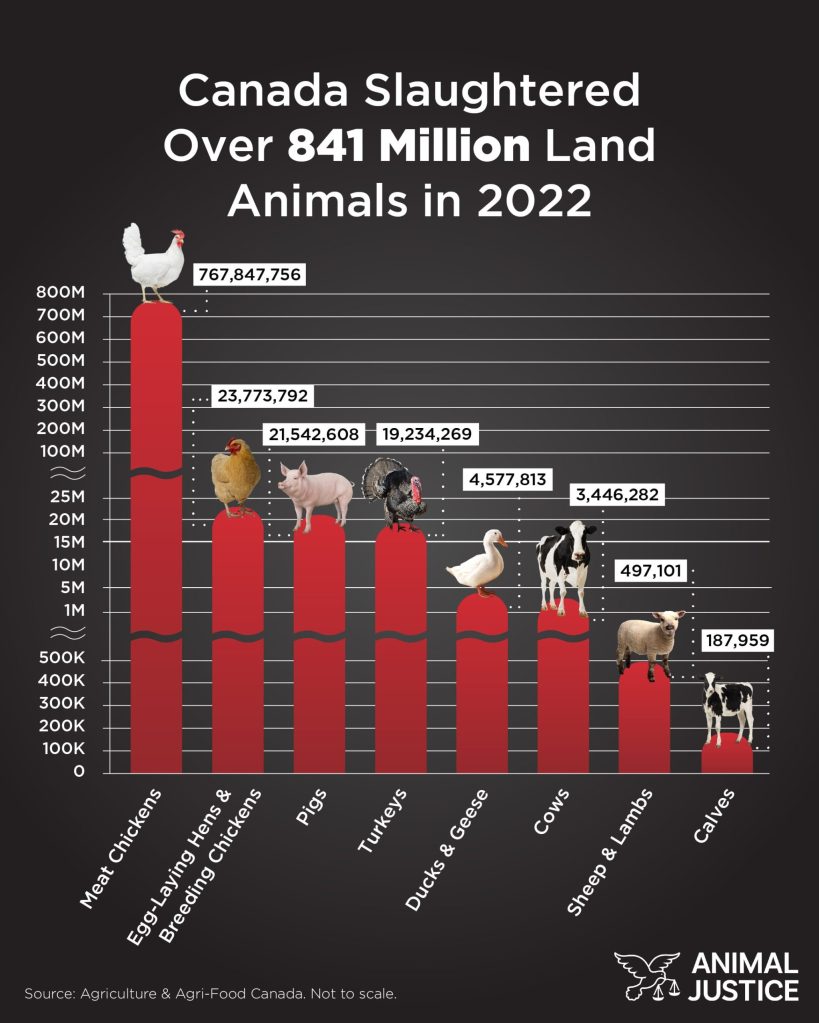
How can it possibly be compassionate or kind to breed animals into existence the way we do? We have forever altered their structure. The chickens, cows, turkeys and pigs we see on farms today are not the same as their wild ancestors. We have altered their structure for profit. Larger pigs = more profit. Cows who produce more milk = more profit. Chickens and turkeys who grow large and fast= more profit. Chickens who lay more eggs = more profit. Everything we do to the animals from birth to death is in the name of profit. Nothing we do is for the benefit of the animals.
Chickens in the wild would lay 10-15 eggs per year. Backyard egg laying hens, battery cage and cage free egg laying hens all come from the same place and have been bred to lay up to 300 eggs per year. This cycle is so hard on the chickens’ bodies that they cannot produce viable eggs after about 1.5 years and are thanked for their service by being sent to slaughter, often ground up to be used for dog food.
While egg laying hens live a prolonged life of suffering in crowded sheds or battery cages, the male chicks fare no better. Perhaps a quick and early death is better, but neither are ideal, and both are horrific. As males do not lay eggs, they are useless to the egg industry and are ground up alive once they are born. Imagine being born, not getting to meet your mother and then promptly being ground up alive? Who have we become as humans that we are ok with this?! Where’s the humanity?! Some places will drown male chicks or place them in garbage bags where they suffocate for days.
Females are sent down one conveyer belt to have their beaks cut – something industry started doing as the chickens started to lose their minds living in such close quarters. Instead of increasing their living quarters and giving the chickens more space, industry decided to clip off part of the hens’ beaks so they could not hurt each other. Not because they care about the chickens, but because pecking hurts profits. Cutting a hen’s beak is akin to cutting off a piece of a human’s nose by the way.
In my Animal Justice Academy course one of the instructors shared a story of when he used to work at a zoo, which was before he went vegan. The zoo would receive garbage bags of male chicks and when he opened the bags there would often be a few dead chicks, still barely breathing who had made their way to the top and hadn’t yet suffocated to death like the rest of the chicks. What a horrible way to go, but this showcases the lack of care industry has for the living beings brought into and stuck in this system.
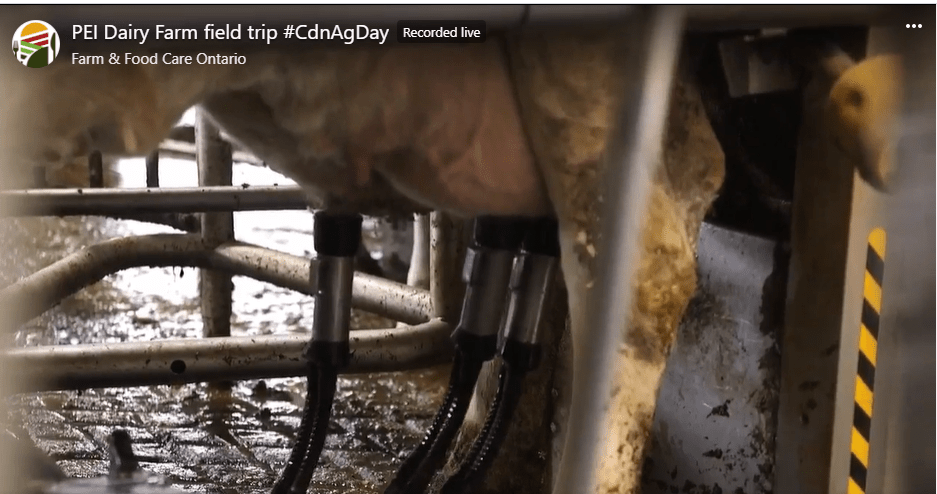
Cows have been bred to produce 10 times more milk than their udders would naturally hold. Can you imagine how painful that must be for them? Farmers say the cows willingly walk up to the machines to be milked. Why yes, I imagine they would as (1) full udders would be painful and (2) Hooked up to the milking robot is often when they get to eat. The dairy industry has figured out that calm cows produce more milk – so the distraction of feeding while hooked up to milking robots helps to increase profits. We take their calves away, the ones WHO the milk is for so that we can steal their milk. So yeah, the cows walk up to be milked because it must be unimaginatively uncomfortable to have your teat hold 10 times more milk than it would naturally hold. Can all my mothers in the room think about what that might feel like for a second and offer a moment of silence for dairy cows?
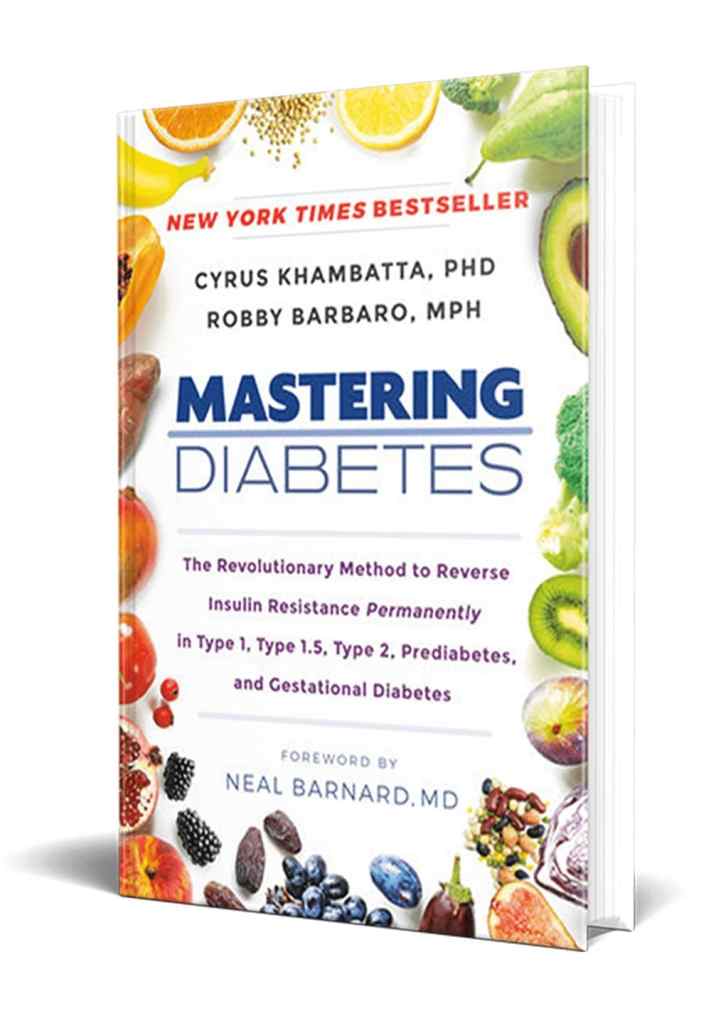
So my fellow habiteer and friend Shannon who has been mentioning veganism to me for years, brings up veganism again in 2020. This time, I am more apt to listen. At the beginning of 2020, I had pre-ordered a book called Mastering Diabetes by Cyrus Khambatta and Robby Barbaro for my husband. I had NO IDEA the authors were vegan. The book was released in Feb 2020 and as that is the same month of my husband’s birthday, I decided to purchase it for him as a gift. He is Type 1 diabetic and I thought there was perhaps some new information on managing his diabetes.
When Shannon brought up veganism again, my husband had already brought it up to me. Two seeds back to back. Paul read the Mastering Diabetes book and told me about these ‘weird guys’ who ate a ton of fruit who were type 1 diabetic and that the research showed that getting the animal products off our plates (read saturated fat and cholesterol) would allow him to have more balanced blood sugar levels, take less insulin and indulge more on fruit and whole grains. Say what now?!
My husband had been diabetic for over 20 years at this point. He was saying much of the research cited in the book had been around for DECADES. Never had a doctor recommended a whole plant food diet to my husband. In fact, they preached outdated ways of eating by pushing the protein myth and telling him to avoid carbs and sugar. Carbohydrates are so vilified and complex carbohydrates certainly don’t need to be feared and they make up 80% of my diet today as a whole food vegan.
So, when my friend brought up veganism, I had just had my husband bring it up and these two seeds had my attention. I told Shannon I was now interested to hear more, and she said I should check out someone named Dr. Michael Greger and his non-profit site, nutritionfacts.org.
I promptly did not check out Dr. Greger’s site but at least I didn’t get defensive and argue this time. I was intrigued. I didn’t understand exactly what nutritionfacts.org was and didn’t see how it could help me. I wasn’t much of a calorie counter after all and didn’t want to look up a bunch of nutrition labels (I completely misunderstood the purpose of the site). I’m sure she explained it to me, and she asked me to check out the site for myself and I said I would, but I didn’t.
I did feel like there was something to this veganism thing that I should try out. Together, Shannon and I decided to go vegan for the month of June in 2020 which we both did, and both promptly fell into a black hole of despair.
I didn’t know what to cook. I didn’t fully understand why eating this way was so beneficial. I didn’t know much of anything except an inkling that this was the path I needed to take.
I made countless recipes that month that were failures. I couldn’t expand my non-vegan mindset to figure out how to build a well-balanced vegan meal. I was stumbling along; I was hungry because I wasn’t eating enough food. When I scoured my cookbooks for a recipe to make, shopped for the ingredients, made the dish and ultimately threw it out because it was bad, I felt beyond frustrated and overwhelmed. This put me in a black hole of despair. I felt like SUCH a failure.
I’m going to stop here in the story because this has been a lot for my dear readers, and I’ll carry on with this story next week. The spoiler alert is, you already know I figured this all out using Tiny Habits. 🙂
I do not expect anyone to change after reading this story and I am not here to judge anyone, but I am here to plant seeds like my friend Shannon is so skilled at doing, to speak up for the animals and encourage you to learn and to progress in your own journey. We all have our own path and I respect both the advocacy of my vegan friends along with the choices my non vegan friends make. I was once you, so I understand. I have suffered from food addiction, believed industry marketing and had a lifetime of cultural conditioning to undo. None of these have been easy for me to overcome so I extend an olive branch of compassion to everyone reading this. I only hope for a better world for all beings who live here.
Peace, love & plants,
Michelle 🙂
p.s. If you feel ready to watch additional footage of what happens to the animals, I recommend The Land of Hope and Glory, Dominion and Seaspiracy (available on Netflix). If you do watch, please make space to watch and fully immerse yourself in the footage and make time and space afterwards to digest what you have seen. Please know that the animals suffering in these videos are no longer suffering as they have long since passed, but there are animals currently stuck in our animal agriculture system who are suffering just like those in the video. We can make a difference for these animals every day by what we put on our plates and we can use our voices to speak up for those who cannot speak up for themselves.
 From Pizza Addict to Vegan
5 responses to “My Hangups with Veganism”
Wow…such a powerful post, Michelle. Thank-you for being real about what your life pre-vegan was like. I’m sure lots of us can identify with it.
LikeLike
You are the best!! Thank you for being the best coach, for everything you do for the animals and for reading my little blog. 🙂
LikeLike
Are you kidding? I love your blog!!
LikeLiked by 1 person
excellent blog!! your story will be able to resonate with so many people who are struggling with getting past what they see as “impossible” barriers to veganism.
LikeLiked by 1 person
Aww thank you so much for reading and commenting. Means a lot.
LikeLike